Dept. of Education Apparently Has Authority to Waive At Least Some Pell Grant Requirements Without Congressional Approval

Politico published an interesting story last week by Libby Nelson on the potential executive actions the administration could take to address some of the President’s higher education proposals. This section, in particular, caught my eye:

The Education Department could also give colleges the flexibility to test new programs by waiving financial aid rules. The department already experiments with new approaches to financial aid. One current experiment allows students who already have a bachelor’s degree to get another Pell Grant — not typically allowed — so they can enroll in a vocational program.

Colleges volunteer to participate in the experiments, and the Education Department has the authority to waive legal requirements. A similar approach could be used, at least on a small scale, to try out additional innovative programs.

Obama singled out a program at Southern New Hampshire University that allows students to earn degrees at their own pace by completing readings and taking tests to show how much they’ve learned. Other experiments could let students use financial aid to pay for tests that let them earn credit for skills picked up outside the classroom. Or they could expand federal financial aid to include high school students earning college credit through dual enrollment programs. (my emphasis)

This section—particularly the last sentence—raises the question as to whether the administration could/would use this authority to provide something resembling “ability to benefit” (ATB) Pell Grant eligibility for certain adults or out-of-school youth without a high-school diploma—perhaps on an “experimental,” college-by-college basis. (ATB was eliminated in a budget deal back in 2012.) There have been proposals in recent months to try to legislatively restore ATB for students enrolled in certain dual enrollment programs—could something similar be done via administrative action?

(Putting aside for now the equity issue raised by restoring ATB eligibility only for students with access to certain approved programs.)
Catching up on Summer Reading: New Book on Health Literacy from National Academies Press

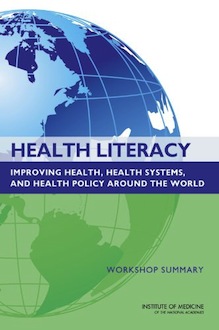
Health Literacy: Improving Health, Health Systems, and Health Policy Around the World: Workshop SummaryThis is (relatively) old news, but in case you missed it, the National Academies Press recently released an interesting new book on health literacy interventions around the world, Health Literacy: Improving Health, Health Systems, and Health Policy Around the World. The book is basically a summary of the discussions and findings that came out of a workshop held here in Washington earlier this year on international health literacy efforts.

You can read it online or download a PDF of the book for free. You can also order a hard copy directly from National Academies or through Amazon.

Michael Lytton, Blog Editor for the American Journal of Preventative Medicine, discusses this publication in a recent blog post the first installment in a short series he is planning to write on the subject of health literacy.

Online Database Helps You Search for Town Hall Meetings and Other Events During the August Congressional Recess

Congress has been on a long summer recess since the end of July, and won’t be back in Washington until after Labor Day. Recess periods often present good opportunities for constituents to communicate with members of Congress. For adult literacy advocates, August isn’t necessarily a great time to invite members of Congress to visit programs, since many of them are also on a break. But there are other things you can do. For example, many members hold town hall meetings, issue forums, and similar events where you can ask questions and voice your opinion. There was an interesting article today, for example, in the The Atlantic, about grassroots activity by both pro- and anti-immigration reform advocates  at such events over the last few weeks (or rather, the surprisingly meager amount of activity by immigration reform opponents).

I recently discovered a handy online, searchable database of events, (screen shot below), created and managed by Americans United for Change, and I thought I’d pass it along. There are still plenty of events coming up over the next several weeks. Not all of them are open to the public and some are very issue-specific, but still, it’s incredibly useful to have all of these events in one big searchable database.

Accountable Congress Database

Interesting New DACA Data to Ponder

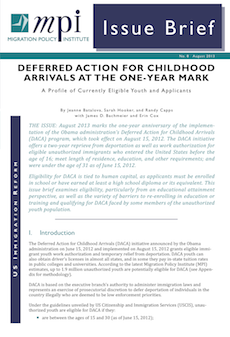
MPI - One Year DACA ReportThe Migration Policy Institute has just published a new policy brief, Deferred Action for Childhood Arrivals at the One-Year Mark: A Profile of  Youth and Applicants, which includes MPI’s most recent estimates on the current and prospective Deferred Action for Childhood Arrivals (DACA) population, and broken down into categories, such as educational attainment, English proficiency, state of residence, country of origin, age, gender, labor force participation, poverty and parental status.

MPI researchers think that about 1.9 million unauthorized immigrants are potentially eligible for the DACA program, with 1.09 million currently meeting the age, education, length of residence, and other criteria. About 392,000 of these individuals are too young to apply now but would become eligible once they reach age 15 if they stay in school or obtain a high school degree or equivalent.

It’s the remaining 423,000 young people who appear to meet everything but the education requirements that are of most interest to adult education advocates. MPI’s brief includes some interesting estimates regarding the educational attainment, English proficiency, state of residence, country of origin, age, gender, labor force participation, income, and parental status for this population. Not surprisingly, these individuals tend to be poorer and less English proficient than those who appear to meet all the DACA requirements. However, more of the individuals in this subset (71%) are in the labor force.