Lobbying for Literacy

State Advocacy 2013The National Council of State Directors of Adult Education recently released the results of a survey on the use of paid lobbyists for adult education  at the state level.
Eight states reported using paid lobbyists. In all of those states, lobbyists are funded by the state adult education professional association. In six of those states, they work for those associations directly. In the other two states, the associations pay for lobbying services by contributing to coalitions that were organized to advocate for a broader range of education and human service programs.

I suspect the actual number of broad-based coalitions that at least do some advocacy that’s at least relevant to adult education funding or policy is actually a bit larger—even if they don’t do it directly. This survey was apparently focused on direct lobbying for adult education. But most statewide coalitions that advocate for funding for human services or education probably at least nominally include adult education as one of those services. It may be that those coalitions are not actively engaging policymakers on the issue of adult education, and/or may not really be working with adult education advocates in the state to integrate the need for adult education into their talking points. Raising the profile of adult education within these kinds of broad advocacy coalitions is a subject worthy of further discussion, I think.

Barriers

Another adult education issue: affordable housing.

“We need to have an apartment without paying a lot of money,” she said. An Alexandria grocery store cashier, Tebeje said she can’t save for school because her rent is so high. “If I get one of these [apartments], I can go to school, too, but now I don’t have time because I work two jobs.(my emphasis)

In Arlington County, Virginia, which borders Washington D.C., more than 3,600 people have applied for the chance to rent one of 122 new affordable apartments still under construction.

All the work that goes into improving adult education curriculum, standards, professional quality, etc. is kind of a waste of time if no one can afford to attend.

See: 3,600 apply for 122 new Arlington apartments – The Washington Post.

International Literacy Day

(Updated Below)

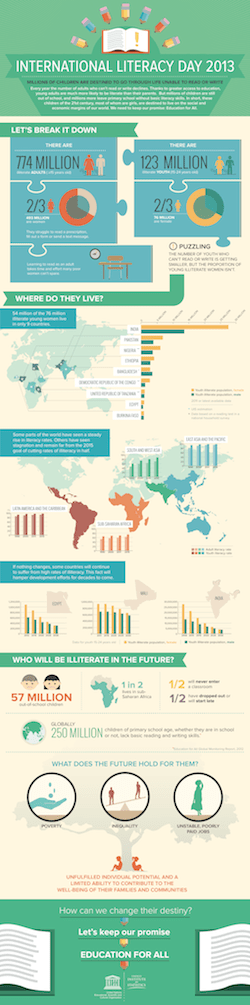
International Literacy Day 2013Today is International Literacy Day, an annual observance aimed at focusing attention on the importance of literacy to individuals, communities, and societies around the world. According to new data released today by the United Nations Educational, Scientific and Cultural Organization (UNESCO), over 774 million adults on this planet do not know how to read or write (two-thirds of which are women), and roughly 123 million children not only lack basic literacy skills, but are often without access to any education at all.

According to UNESCO, on the basis of current trends, 743 million adults will still lack basic literacy skills in 2015, the deadline for the United Nations’ Millennium Development Goals.

September 8th was proclaimed International Literacy Day by UNESCO back in 1965, and first celebrated in 1966. In my experience it tends to get a bit more attention outside the Unites States, although there are events here in the U.S. as well.

Every year, for example, the International Reading Association (IRA) hosts an event marking the day in Washington, D.C. This year’s event, “Career Ready Reading: What Employers Need from Schools and How We Can Work Together,” focuses on the connection between reading skills and career-readiness. This event reflects the IRA’s theme for this year’s ILD: “Invent Your Future,” aimed at highlighting “the crucial literacy skills that prime students for success in school, work, and life.”

UNESCO also picks a theme for each year’s celebration. This year’s theme is “literacies for the 21st century.” According to UNESCO, this means highlighting the need for not only basic literacy skills, but the need to “equip everyone with more advanced literacy skills as part of lifelong learning.”

In his International Literacy Day message, Secretary-General Ban Ki-moon said, “In our knowledge-based era, literacy is a foundation for a more just, inclusive and sustainable world.”

Here are some additional ILD links you may find of interest:

thumbnail of ILD 2013 infographic

  • To illustrate the disparities in adult and youth literacy rates, the UNESCO Institute for Statistics has created an interactive map with literacy statistics from 150 countries and territories, including literacy rates by sex and the correlation with national wealth. UNESCO has produced a huge ILD 2013 infographic (click on the thumbnail on the right for the full version) that highlights these statistics.
  • UNESCO is also hosting a colloquium in Paris tomorrow and Tuesday, entitled, “Advancing towards a Literate Twenty-first Century.” According to UNESCO, the colloquium will discuss the idea of a Global Coalition, a multi-stakeholder Partnership for advancing a literacy agenda proposed to be launched in November.
  • “On International Literacy Day, Let’s Remember the Children Who Don’t Have a Chance to Read” — blog post by Alice Albright, Chief Executive Officer of the Global Partnership for Education.
  • What Literacy has Done for Us” — article from the Norwegian Refugee Council.
  • Editorial in the Gaston County N.C. Gazette.
  • Editorial in the Times-News (Alamance County, N.C.) — “Raising literacy in the community raises us all.”
  • Editorial in Davidson County, N.C. Dispatch.
  • Three ways to celebrate International Literacy Day today  — ChicagoNow
  • Free admission to any Florida state park today for anyone who presents a valid library card, a book checked out from the library, or donates a new or used, family friendly book!
  • Editorial in the Daily Star (Bangladesh)
  • Pakistan will celebrate the International Literacy Day 2013 with a three-day nationwide campaign to enrol at least 500,000 out-of-school children. More on ILD in Pakistan Today. Meanwhile, The U.S. has announced the launch of a new $160 million dollar Pakistan Reading Project to boost the reading skills of 3.2 million Pakistani children.
  • Statement from Tariq Al Gurg, Chief Executive Officer of Dubai Cares.
  • Here is a story about an ILD event at the U.N.’s office in Armenia. And here is one about a similar event in Azerbaijan.
  • Speaking at the International Literacy Day celebration held in New Delhi, Indian President Pranab Mukherjee called for achieving a literacy rate in India that is “at par with leading countries in the world.”
  • Here’s a post I wrote last year on ILD 2012.

And remember, in the immortal words of Krusty: “Give a hoot, read a book.”

Give a hoot, read a book

UPDATE 9/17/13: Here are some more links to ILD 2013 activities and announcements from around the world that I’ve come across since my original post:

Study: Poverty Reduces Brainpower Needed for Things Like Education and Job Training

(Updated Below)

New research out of Princeton University suggests that the stress of poverty requires so much mental energy that poor people have significant less brainpower left in the tank to devote to learning:

A person’s cognitive function is diminished by the constant and all-consuming effort of coping with the immediate effects of having little money, such as scrounging to pay bills and cut costs. Thusly, a person is left with fewer “mental resources” to focus on complicated, indirectly related matters such as education, job training and even managing their time. (my emphasis)

Anyone who has experienced financial difficulties knows how stressful and all-consuming worrying about money can be, but this is one of the few studies I’ve seen that links the stress of financial insecurity to cognitive function. The researchers found that subjects consumed with financial insecurity dropped an average of 13 IQ points—the equivalent of losing an entire night’s sleep.

The researchers go on to suggest that services for the poor should be designed to accommodate this cognition loss:

The researchers suggest that services for the poor should accommodate the dominance that poverty has on a persons time and thinking. Such steps would include simpler aid forms and more guidance in receiving assistance, or training and educational programs structured to be more forgiving of unexpected absences, so that a person who has stumbled can more easily try again.

I would take this even further and suggest that this research supports the argument that, overall, we’d see better retention and greater learning gains in adult literacy and adult education among the poor if we alleviated the highly stressful conditions associated with poverty before they enrolled in a program of study or training, instead of just trying to accommodate those stressful conditions as they go along—somewhat analogous to the “housing first” approach to combating homelessness, in which providing stable, permanent housing is viewed as a critical first step before a homeless individual or family can be expected to address the issues that led to homelessness.

Adult education policy is based in large part on the premise that increasing educational opportunity will provide people with the skills they need to lift themselves out of poverty, which in turn is based on the premise (presumably) that a poor person’s lack of education is the primary reason (or at least one of the major reasons) that they are poor to begin with (as opposed to a lack of jobs, a decent wage, child care, health insurance, etc.)

Increasing funding for adult education is a strategy that seems primarily aimed at increasing access to adult education, but if our policy goal is to help people living in poverty  become successful adult learners, this study suggests that removing the highly stressful conditions of poverty for poor individuals before they embark on a course of study is an equally important strategy, instead of relying on adult education to lift them out of poverty after they have achieved some measure of academic success and confidence.

If so, then perhaps advocating for strong anti-poverty measures, such as living wage bills, or against proposals to cut SNAP benefits, needs to become part of the adult education field’s legislative strategy.

h/t Smithsonian SmartNews

UPDATE 9/3/13: The paragraph above that begins “I would take this even further” has been edited a bit so that it would read a little bit better.

Also, it occurred to me this afternoon that this program, which provides low-income single mothers enrolled in college with subsidized housing in residential communities with on-site child care, is a good example of an approach to adult education (in this case, in a community college context), that provides learners with initial and ongoing economic stability (in the form of housing and childcare). Perhaps, in addition to the broad-based antipoverty measures suggested above, policies that encourage the adoption and expansion of program models like this one should also be in the mix.