Second Chance Act Reauthorization Adds Support for Adult Education

Looking for a small federal policy win for adult literacy? Then I invite you to take a look at The Second Chance Reauthorization Act of 2013, a bipartisan (!) bill recently introduced in both the House and the Senate containing language that appears to open up a Department of Justice grant program to adult education/literacy providers by making it explicit that such services qualify.

Signed into law on April 9, 2008, the Second Chance Act (P.L. 110-199) authorizes federal grants to government agencies and nonprofit organizations that provide support strategies and services designed to reduce recidivism. There are two grant programs associated with this legislation, both administered by the Office of Justice Programs in the U.S. Department of Justice: the Bureau of Justice Assistance awards Second Chance Act grants serving adults, and the Office of Juvenile Justice and Delinquency Prevention awards grants serving youth returning from the juvenile correction facilities.

Last November, a bill to reauthorize the Act (S. 1690) was introduced in the Senate by Sen. Portman (R-OH) and Sen. Leahy (D-VT), along with an identical bill in the House (H.R. 3465), introduced by Rep. Sensenbrenner (R-WI) and Rep. Davis (D-IL).

The reauthorization bill(s) offer more explicit language regarding the types of transitional services that may be provided by grantees funded under this grant program. It explicitly identifies education and literacy as one of the transitional services that may be provided by grantees. I know zippo about how/why this language got in there, but if the bill passes with this provision intact, it seems to me it presents an interesting opportunity for adult education providers.

The document below (click on it for a PDF) highlights the pertinent section. The new language is in bold.
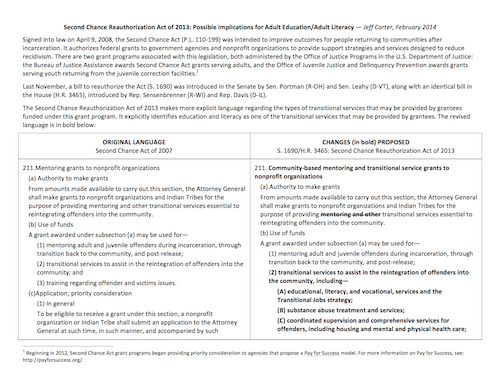
Second Chance Reauthorization Act of 2013

Federal Adult Education Funding: Updated Table/Chart

I recently updated a chart I made back in May of 2013 showing AEFLA (i.e. WIA Title II) spending over time since 2002, in both nominal amounts and inflation-adjusted dollars. The reason for the update? We now have final CPI figures for 2013. The result isn’t much different from my original, which used the rate of inflation as of April 2013, but I thought it was important to update the chart with the final 2013 figures.

The bottom line is pretty much exactly why I estimated back in May: in terms of real dollars, the federal investment in adult education has dropped by nearly 23% since 2002.

AEFLA Spending 2002-2013 - Inflation Adjustments

(Click on the chart for a larger, less fuzzy version.)

As I noted when I put this together in May, for FY 2010, I did not include the one-time adjustment made by the Department of Education to make up for several years of underpayment to some states—that anomaly wasn’t carried over and shouldn’t be interpreted as growth.

North Carolina Justice Center on the GED

I’ve been trying to keep a special eye on policy papers outside the adult education world related to the GED revamp, particularly those that come at the issue from a civil rights, social justice, or economic policy point of view. Here’s one from the North Carolina Justice Center that came out back in November that I missed. It’s a good summary of the potential challenges that the new test may pose to low-income adults. It closes with a critical point:

While these challenges are significant, the changes to the GED test also offer an opportunity for states to reflect on ways to better meet the needs of this target population. (my emphasis)

This has been a point that I’ve been stressing (I hope) since the Pearson VUE partnership spurred several states to look for GED alternatives last year. Whatever you think of the GED and its new competitors, the rapid evolution of the HSE testing marketplace does appear to be forcing policymakers and state officials outside of the adult education office to spend some time actually thinking about the needs of this population. Whether this leads to more investment in adult education and/or policies designed to assist more adult learners to succeed is still an open question.

h/t Adrienne Harreveld

Here We Go Again

I’ve written before about the inherent problem with instituting an adult education requirement in order to qualify for a government benefit (as have others), but in light of this recent Labour proposal in the U.K., it’s worth repeating the basic problem with this kind of proposal: it’s only fair, and only works as policy, if access to adult education is free and universal. There are other problems, potentially, with adding new requirements to benefits already earned (which is the case with unemployment benefits in the U.S.) but such proposals are fundamentally flawed at the start if a lack of available adult education opportunities make the education requirement impossible for beneficiaries to meet. If Labour is also proposing a massive new investment in adult education and training (and I mean truly massive), that’s one thing, but it’s not clear from this piece in The Telegraph  that such an investment would be accompanying the new education requirement in their proposal:

People receiving Jobseeker’s Allowance would be forced to sit a basic skills test within six weeks of signing on or face being stripped of their benefits, Labour will say, in a move designed to challenge the Tory’s popular welfare policies.

Anyone who does not show basic competency in literacy, numeracy and IT will be sent on training programmes.

Labour believes that around 300,000 people could be sent on courses every year. If they refuse, they will be denied welfare.

Maybe I’m completely uninformed, and the U.K. has 300,000 empty seats in their adult education and training programs. But if not, I’m not sure how this plan is supposed to work.

Note also that expanding a system to accommodate 300,000 more learners is not just a question of pumping more money into programs. To achieve anything close to universal access to adult education, you’d have to think through a strategy that puts in place some combination of physical program and/or on-line learning that is distributed in such a way that it is truly accessible by all, and you’d also have to figure out some way to ensure that individuals could carve out the time and distraction-free space to successfully engage in learning (all of which might require additional investments in broadband access, transportation, and childcare—just to name three examples).