There’s more to say about it, (and you can read what other people are saying here and here), but for now I just have time to note one interesting thing about the new bicameral, bipartisan WIA reauthorization bill unveiled last week, which is that it authorizes specific funding amounts for each title, including Title II—the part of the bill that funds adult education. It holds FY 2015 funding for adult education at the FY 2014 level, but authorizes gradual increases in subsequent years (see Section 206):
| Fiscal Year | Amount |
|---|---|
| FY 2015 | $577,667,000 |
| FY 2016 | $622,286,000 |
| FY 2017 | $635,198,000 |
| FY 2018 | $649,287,000 |
| FY 2019 | $664,552,000 |
| FY 2020 | $678,640,000 |
Unfortunately, by carrying over the FY 2014 funding level to the first year of the new Workforce Innovation and Opportunity Act, or WIOA (which is what the new bill is called), adult education state grants would almost certainly be left stuck at its sequestered funding level until at least FY 2016. While many other line items were at least partially restored under 2013’s Bipartisan Budget Act, which provided sequester relief for FY 2014 and FY 2015, adult education state grants under WIA did not. In other words, WIOA locks in that sequester cut. I know I keep beating the drum about the sequester cut not being restored, but I haven’t heard or read much mention of this in discussion about the bill. It’s disappointing that the funding levels for adult education in WIOA start at a level below where it should be.
Of course, this disappointment is mitigated somewhat by the fact that restoring that cut or receiving any increase at all in FY 2015 was and is pretty unlikely anyway, which I’ll get into below.
The annual increases beginning in FY 2016 are welcome, of course—but how likely are they to actually go into effect? Not very likely, I’m afraid (again, I’ll get into that below). So why include them?
An alternative approach that Congress often uses in authorizing legislation is to simply authorize “such sums as may be necessary” and let Congressional appropriators figure out later on what that figure(s) will be. (For a primer on the authorization/appropriations process, this CRS report may be helpful.)
Generally speaking, your view on whether setting the funding levels in authorizing legislation is a good idea or not is going to be largely determined by your assessment of two factors: (a) whether you think the amounts authorized are sufficient for your program, and/or (b) whether you think that appropriators, under the “such sums” scenario, would be inclined to give your program more funding if they are unconstrained by any authorized limits. If not, then setting the sums in the authorization legislation—even if lower than desired—might be better than leaving no guidance for appropriators at all, even though there is no guarantee that appropriators will provide all of the funding authorized.
In this case, it’s pretty clear the answer to (a) is no. Until just a few years ago, the National Council of State Directors of Adult Education and the National Coalition for Literacy were routinely advocating for a minimum of $1 billion for Title II. We know that the federal adult education system has never served more than around three million people of the approximately 36 million who need such services (according to the most recent estimates), and currently serves only about 1.8 million. And once you factor in inflation, it looks to me like the increases to adult education authorized by this bill will still be be well below 2002 funding in terms of real dollars, which means it’s very unlikely that enrollment in programs would increase much under the Act. (It’s possible that alternative and/or more efficient instructional delivery models could increase access to adult education in general, even if traditional program enrollment remains stable or goes down, but right now no one can say for sure that this will actually happen.)
Take a look at the chart below. The first two columns show you the appropriation history for adult education since 2002 plus the funding levels specified in WIOA through 2020. The third column provides the portion of these funds reserved for state formula funding. (The rest goes to national leadership activities. See this post for an explanation of how the funding for adult education is divided up.) The fourth column provides the inflation percentage change from the previous year. Using those inflation rates, the fifth column shows you the value of each year’s state grant allocation in 2002 dollars. (I used 2002 as my starting point because that’s what I used here.) For future years under WIOA, I estimated an annual inflation rate pretty conservatively, at 1.5% for each year funded under the Act, and I estimated the amount of funding that would be available to states via formula funding based on how the funding is split now, with about 2% skimmed off for national leadership activities. (Click on the graphic for a larger view of the chart.)
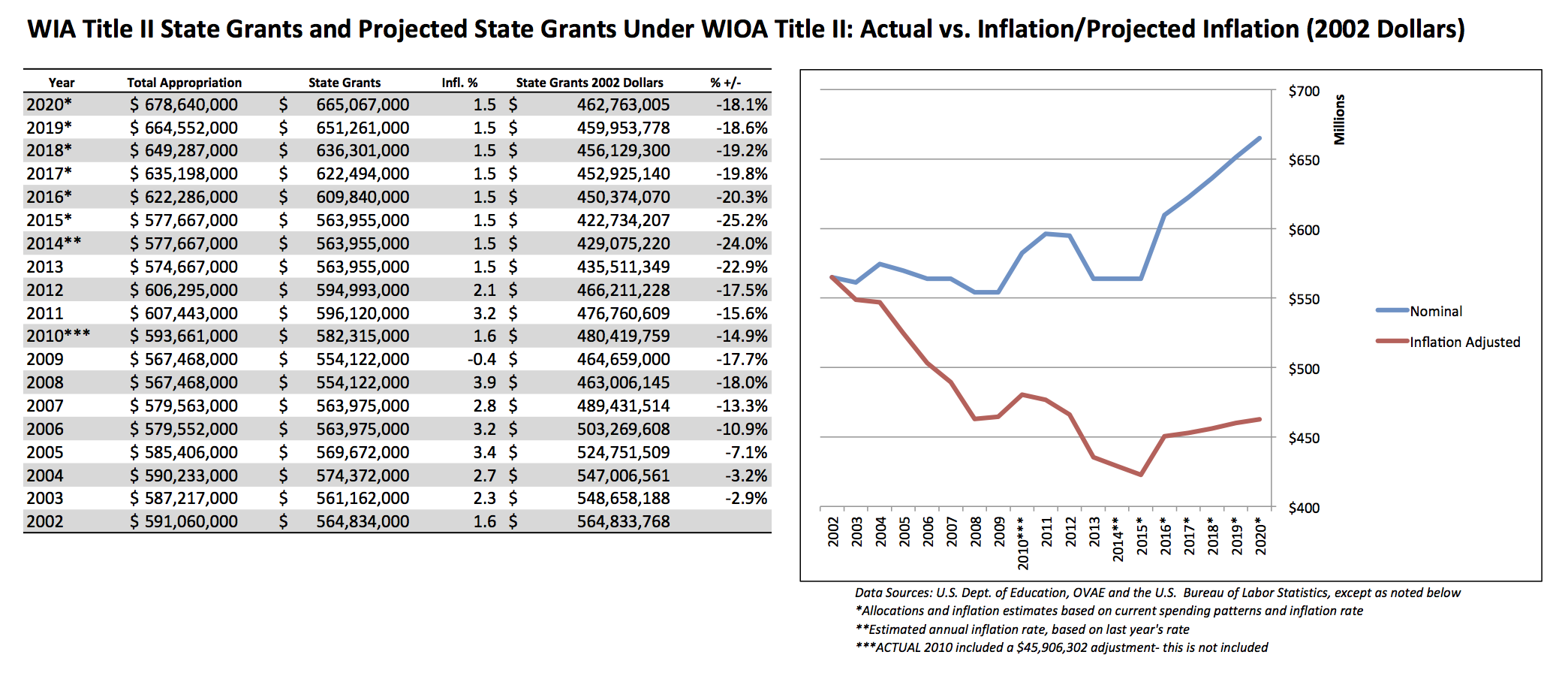 Bear in mind that for future years this is all a very rough calculation using best guess estimates, but I think it’s actually a pretty conservative analysis. It’s hard for me to come up with any scenario in which federal adult education funding levels proposed in this bill ever approaches anything near where it was in 2002 in terms of real buying power. If anyone else can come up with one, please let me know.
Getting back to this question of whether setting the funding levels in authorizing legislation is a good idea or not, the other part of the analysis, as I mentioned, is whether you think that under a free-wheeling, fund-it-however-much-you-want “such sums” scenario, appropriators would be inclined to give your program more funding during the life of the program if they are unconstrained by any authorized limits. Here again, the answer would appear to be no. It’s pretty clear that unless Congress raises the existing budget caps and eliminates the mandatory cuts under sequestration (which otherwise will return in 2016)—a very unlikely scenario—it is very, very unlikely that federal adult education funding would receive any increases over the next several years. Further cuts are more likely, actually.
You might therefore come to the conclusion that while effectively capping funding at levels in the authorizing legislation well below what’s needed is not such a great idea, on balance it’s still probably better than leaving it at “such sums,” since at least the legislation sets up increases. And I’m inclined to agree with you, but the bad news is that there’s no guarantee that appropriators will actually appropriate funding at those authorized amounts either (they’re not bound to do so). Again, as long as those budget caps and the mandatory cuts under sequestration are still in place, there isn’t much of a chance that the program will ever be funded at the levels authorized.
But authorizing modest increases in the authorizing legislation at least provides advocates with the opportunity to make the case during the annual budget and appropriations process that Congress intended for the program to grow. Which is something. But the increases in funding authorized by WIOA are clearly inadequate, and unless the restraints on federal spending are loosened sometime during the life of the legislation (assuming it passes, and all indications are that it will), it’s unlikely that even the marginal increases authorized by WIOA will ever see the light of day.
 Literacy & Policy