Literacy for Work – Why Novels Count Too

Yesterday a major report was released examining the impact of illiteracy and innumeracy in the U.K. I was reading some of the responses to that report last night, and I came across a really smart blog post by Brian Creese of the U.K.’s National Research and Development Centre for Adult Literacy and Numeracy. His post included a superb description of how literacy skills are actually used in the workplace, while simultaneously arguing that reading for pleasure is a critically important component of literacy development:

The use of literacy and numeracy skills in the workplace is complex; different jobs, and the various elements within them, involve a range of literacy and numeracy practices, with workers often learning the specific skills they need for their job from peers and co-workers. Employees consistently report that they have adequate skills to do their jobs. What we see in the workplace is that we often work with others in ways that maximize our strengths and allow us to learn from them. We also see how workplaces can be adapted to remove the demand for literacy and numeracy or to scaffold its use.

Despite the policy focus on the workplace, we have continued to work with emergent adult readers on reading for pleasure. Those less confident with their reading may get great joy from reading novels, biographies or other texts in supportive, collaborative environments. They use adult experience and expertise to develop reading confidence, skills and practices gradually and communally – and in doing so are more able to tackle some of life’s other challenges, such as job interviews or finding better heating deals. (My emphasis)

This read to me like a gentle push back against rigidly contextualizing adult literacy instruction, at least insofar as it suggests a practical benefit from developing a habit of reading for pleasure, regardless of context.
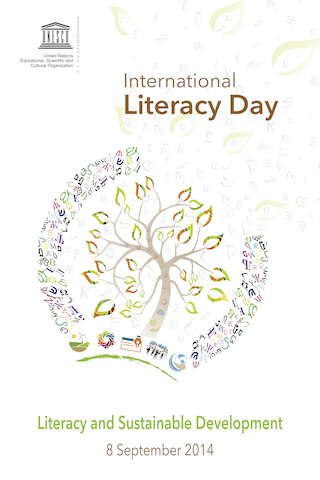
International Literacy Day 2014

ILD 2014 Poster(Updated Below)

Today is International Literacy Day, an annual observance aimed at focusing attention on the importance of literacy around the world. There are events in schools and communities around the globe today to mark the occasion, including a United Nations conference in Dhaka, Bangladesh.

The theme of International Literacy Day 2014 (ILD 2014) is “Literacy and Sustainable Development.” According to UNESCO, “[l]iteracy is one of the key elements needed to promote sustainable development, as it empowers people so that they can make the right decisions in the areas of economic growth, social development and environmental integration.”

This UNESCO page has links to some of the more prominent ILD 2014 events. Here are a couple of other interesting ILD 2014-related announcements and news items that have come across my desk this morning:

  • In the U.K., the House of Commons Business, Innovation and Skills Select Committee has published a report examining the impact of illiteracy and innumeracy in England, calling on the government to launch a national campaign to address the issue, which they say is undermining the UK’s economic performance.
  • At an ILD 2014 event in India, President Pranab Mukherjee called for the “complete eradication” of illiteracy from the country, with a particular focus on improving literacy rates among the most disadvantaged sections of Indian society.
  • The Philippine Daily Inquirer has marked the day with an interesting story about a woman in the Philippines who made a decision to re-engage with education after being belittled by her employer.

A few interesting opinion pieces:

  • Lifelong Learning for Literacy and Sustainable Development – Worrel Hibbert, Executive Director of the Jamaican Foundation for Lifelong Learning, writes about Jamaica’s implementation of a new High School Diploma Equivalency (HSDE) programme for adult learners. (More from Jamaica here.)
  • How Adult Literacy Is Transforming a Village – Craig and Marc Kielburger, co-founders of the international charity, Free The Children, write about an adult literacy class in the south-central China village of Waer, where residents are still recovering from the 2008 Sichuan earthquake.
  • An editorial from the Gaston Gazette (North Carolina) argues that “before job-ready education can begin, a student and prospective worker must be able to read.”

International Literacy Day celebrations are generally more prominent outside of the Unites States, although many adult literacy programs mark the day with events or announcements. For example, in New York, LiteracyCNY has posted a 52-year retrospective of their work in the community.

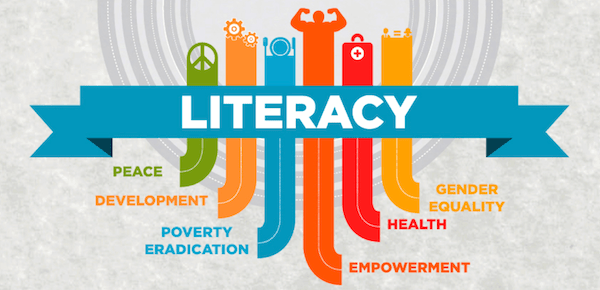
Finally, those of you who are fans of infographics, here is the official UNESCO ILD 2014 infographic (click on it to see the entire thing):

Link to ILD 2014 Inforgraphic

This is just a teaser—there will be hundreds of events and surely more news about ILD 2014 as the day progresses. I don’t have time to track it all, but I encourage you poke around the inter webs today and see what else is out there. Find anything interesting? Want to promote an event in your community? Feel free to post it in the comments.

UPDATE 9/8/14 2:30 PM: Had some time during my lunch break to poke around for some additional stories. Here is the best of what I found:

Some additional opinion pieces:

Joan Rivers’ Literacy Connection

RIP Joan Rivers. There is a literacy connection that some of us of a certain age may recall: Rivers served as the narrator for the Adventures of Letterman cartoons that used to run during the old 1970s PBS show, The Electric Company. The Electric Company was created to help elementary school-aged children children develop their grammar and reading skills—more or less grad school for the original Sesame Street generation.

The Real Problem With WIOA

I’m still confused over why the Workforce Innovation and Opportunity Act (WIOA) is already considered an abject failure because it didn’t do anything about the predatory lending practiced by institutions covered by an entirely different piece of legislation, but in the meantime, while watching this, I was pleased to see someone mention, even if somewhat obliquely (and then completely ignored by the host), the one clear aspect of WIOA (and its predecessor, the Workforce Investment Act) that really does work to the advantage of those schools that rip people off: the fact that there isn’t nearly enough funding in WIOA to provide quality training to people who are eligible for the program. If people had better options, maybe they wouldn’t be in a position to be taken advantage of by these terrible schools.

I’ve written about the completely inadequate funding levels for adult education in WIOA here. I’m not an expert by any stretch on the job training programs covered in WIOA, but I gather from what little I do know that the funding for these programs is inadequate as well. If people think that it’s the WIOA-funded one-stops that should be counseling people about higher ed student loans, then in their next breath it night be good to talk a little about whether one-stop staff capacity is sufficient—or sufficiently knowledgable—to do this, and if not, what kind of money it might take to  make that happen.

Again, I’m really interested in how workforce investment advocates might do more to stop the higher education scam artists that prey on the unemployed and unskilled, but most of the discussion over the last week or so hasn’t been very clear about the differences between higher eduction and WIOA, how they actually work together, and how they could work together better, given such a restrictive funding environment. Without such clarity, it’s hard to know which policy choices, if any, will make a difference. This is one area where your comments would be much appreciated!